Four in ten European employers do not know what skills they will need in their organisation in next two years
Half of HR professionals put workforce planning at the top of their agenda
March 19, 2026
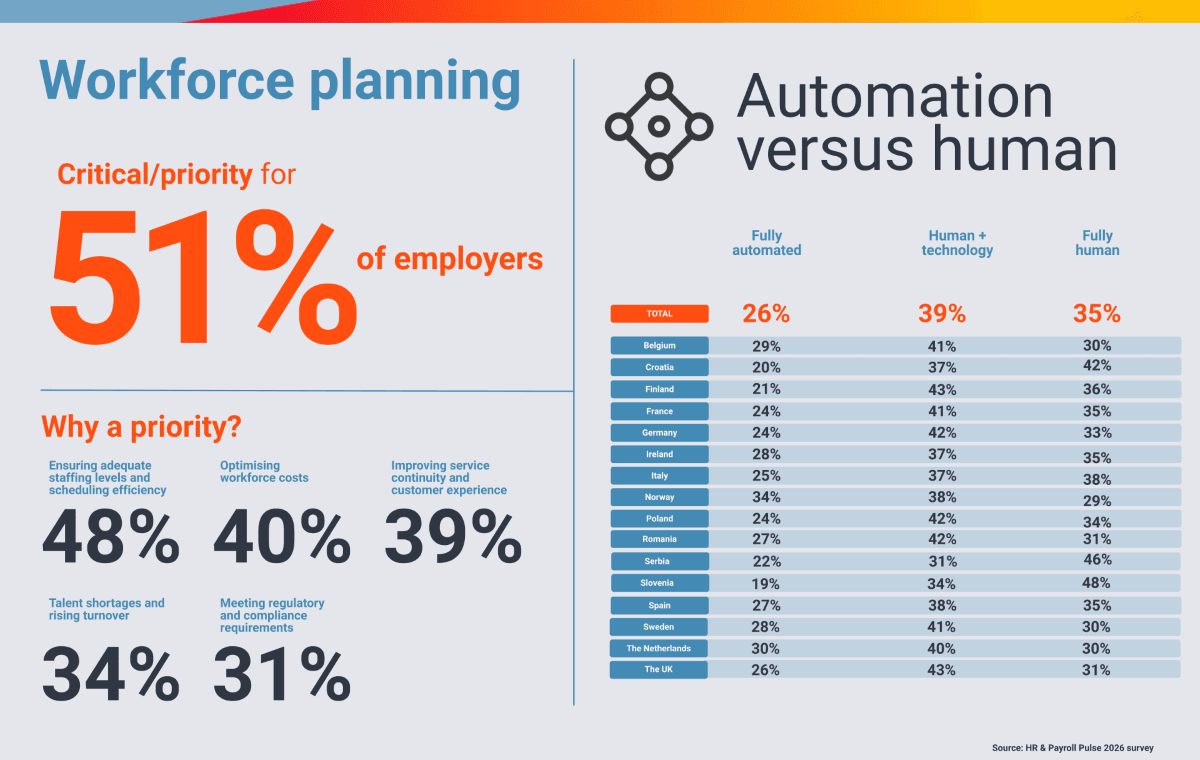
Just over half (51%) of European HR professionals consider workforce planning to be a high priority in 2026. Ensuring that there are enough staff to get the work done and being able to plan more efficiently are high on the agenda. This seems to contrast with the rise of automation and AI. A quarter of HR professionals (26%) cite these technological developments as the very reason for focusing more strongly on workforce planning. Another striking finding is that organisations are increasingly looking at skills and competencies rather than job titles when hiring staff. This is according to new research by European HR solutions provider SD Worx, which surveyed 5,936 HR managers and 16,500 employees in sixteen European countries.
From AI to talent shortages: HR professionals are focusing more on workforce planning for a variety of reasons. More than half of employers (51%) consider workforce planning to be an important priority for 2026. First and foremost, they want to guarantee sufficient staffing levels and make planning more efficient (48%). This is followed by keeping personnel costs under control (40%) and ensuring continuity in service provision and customer experience (39%). Talent shortages and increasing staff turnover (34%) and complying with complex regulations (31%) complete the top five. Technological developments also play a role: 26% are focusing more on workforce planning to prepare for automation and AI.
55% look beyond job titles when planning staffing
The way organisations approach workforce planning is also changing. More than half of employers (55%) no longer focus solely on job titles, but increasingly on skills. Almost three in ten (29%) focus on strategic workforce planning rather than operational planning, identifying future personnel needs and skills. A third focus on both. At the same time, four in ten employers (39%) do not yet have a clear picture of the skills their organisation will need in the next two to three years.
66% of employees find internal mobility within their organisation difficult
More than half of employees (54%) feel that their talent and potential are not being fully utilised in their current role; only four in ten (41%) see opportunities for growth or a change of role within the organisation. Two-thirds (66%) also feel that their organisation does not make it easy to explore internal jobs, roles, or projects that match their skills and interests.
Employees are slightly more positive when it comes to daily planning. Six in ten (59%) are able to coordinate their work smoothly with colleagues, and 46% feel that the team plans efficiently and in a structured manner. However, many organisations still lack the necessary support: almost six in ten employees (58%) say that their organisation does not provide suitable technology to plan their work effectively.
39% prefer a combination of people and technology in workforce planning
According to 61% of employers, managers today do indeed have the necessary technology to plan their staffing capacity effectively. Such systems are also gaining in importance, especially when supported by AI. Nevertheless, the human role remains important: for the time being, only a quarter of employers (26%) believe that workforce planning should be fully automated, while 39% prefer a combination of humans and technology. When it comes to time registration, three in ten (31%) employers are open to full automation with AI.

About the international employee survey
SD Worx, the leading European HR and payroll solutions provider, supports small and large organisations with their HR and payroll challenges. To keep its finger on the pulse of employers and employees, SD Worx regularly conducts in-depth surveys across Europe. The analysis of the latest ‘HR & Payroll Pulse’ survey offers organisations valuable insights to sharpen their HR and payroll strategy and make it future-proof.
The survey was conducted between January 27 and February 20, 2026, by the SD Worx Research Institute in sixteen European countries: Belgium, Germany, Finland, France, Ireland, Italy, Croatia, the Netherlands, Norway, Poland, Romania, Serbia, Slovenia, Spain, the United Kingdom, and Sweden. A total of 5,936 HR decision-makers and 16,500 employees were surveyed. The results provide a representative picture of the labor market in each country.
About SD Worx
SD Worx is the leading European HR, Pay and Time partner, helping organisations run the essential processes that employers and their people rely on every day, from paying employees correctly to managing time, data and compliance across the employee lifecycle.
As the backbone of work, SD Worx brings together technology, expertise and service delivery in one integrated solution. This allows organisations across Europe to manage HR, Pay and Time in a consistent and reliable way, supported by local knowledge in each market and a strong European presence. The solutions create room to grow and are designed to support day-to-day operations, giving organisations confidence.
SD Worx supports more than 100,000 organisations, pays over 6 million employees each month and achieved revenues of EUR 1.3 billion in 2025.
More information on www.sdworx.com / Follow us via LinkedIn.
Press contact