One in three people over 50 wants to continue working past retirement age
October 15, 2026

Europe is dealing with a growing labor shortage, and governments are taking action by raising the retirement age to slow the rapid outflow of workers. How does the average employee view this? New research from the European HR firm SD Worx shows that as many as 1 in 3 employees aged 55 and older are willing to continue working for a while after reaching the statutory retirement age. Among employees under 35, that figure is slightly lower, but still more than one in four. Job quality is, however, an important factor in this regard.
Europe is facing labor shortage
Recent figures from Eurostat show that Europe’s population is aging rapidly. While 17% of the European population was 65 or older in 2005, that figure is projected to rise to 22% by 2025. According to the European Commission, the European labor force is expected to shrink by about 12% between 2022 and 2070, despite higher labor force participation rates among older adults and women.
European companies are already feeling the impact: more than half (52%) of European HR decision-makers say there is a shortage of staff. This is particularly evident in Slovenia (64%), Croatia (57%), Ireland (57%), and the Netherlands (57%). Norway (56%), Germany (55%), and the United Kingdom (54%) follow closely behind.
Not age but job quality determines the choice
That is precisely why it is striking that older employees are not necessarily more inclined to retire early than their younger colleagues. For example, half of those aged 55 and older say they would prefer to retire early, compared to 61% of employees under 35. Furthermore, nearly one in three people aged 55 and older (32%) are willing to remain active even after reaching the statutory retirement age.
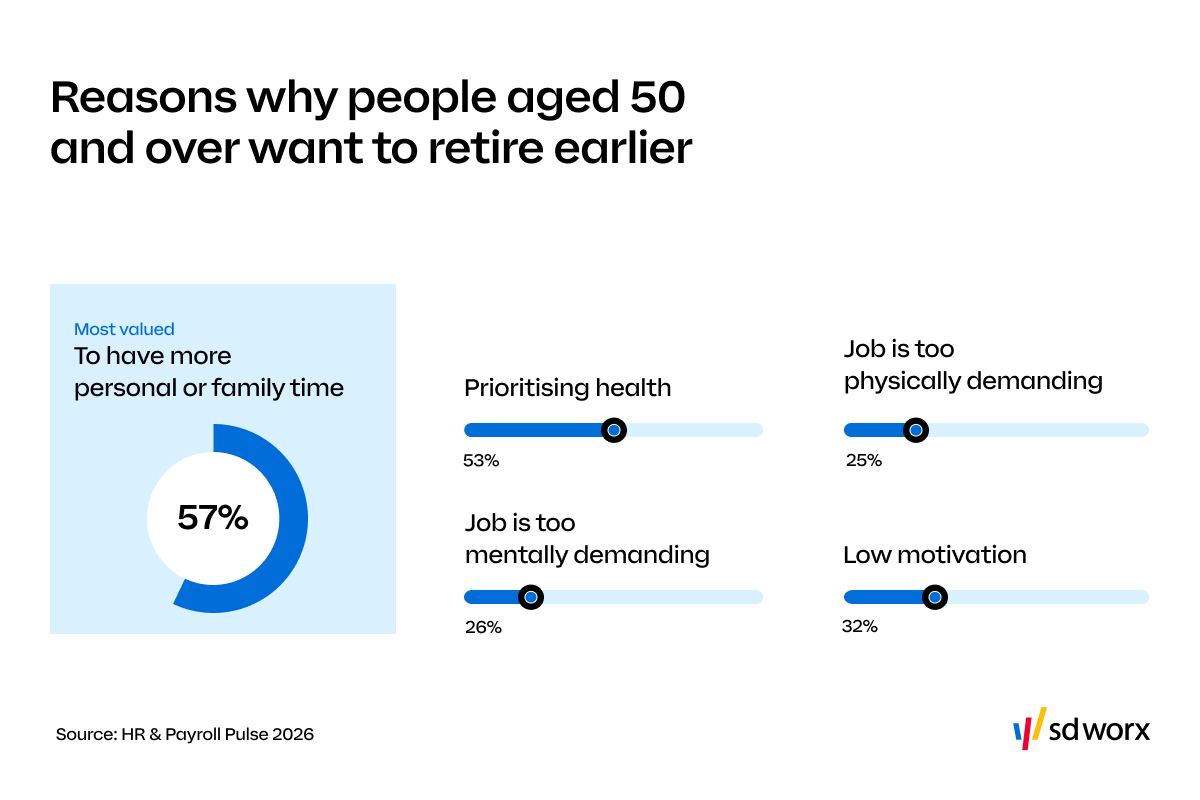
When older employees do want to retire early, financial motives play a role remarkably rarely. The main reasons are more time for family or personal matters (57%), health (53%), and the desire to achieve certain life goals (40%). Declining motivation (32%) and physically (25%) or mentally (26%) demanding work also play a role.
The fact that older employees want to continue working longer may be related to how they view their work experience. For example, 76% of those aged 55 and older feel energetic enough to do their jobs well, and about 80% find sufficient fulfillment and meaning in their work. Among employees younger than 35, that figure is significantly lower (68%). There is also a difference between the two generations in terms of overall job satisfaction: 78% of those aged 55 and older are satisfied with their work, compared to 71% of younger employees. Older employees also report a higher sense of recognition: 65% feel recognized, compared to 59% of employees under 35.
This positive job experience is also linked to a different perspective on one’s own career. While younger employees are more often open to a new job or position, those over 55 seem to feel less of a need for change.
Less mobility, less drive to develop
As expected, labor market mobility among older workers is significantly lower. Only 5% of workers aged 55 and older are actively looking for a job at another organization, compared to nearly 1 in 5 (19%) of workers under 35. Even within their own organization, workers aged 55 and older are less likely to seek a different position (4% versus 18% among younger colleagues). This may also indicate that they feel less of a need for change: 83% are not currently looking for another job outside their own organization. Within their own organization, that percentage rises to as high as 86%.
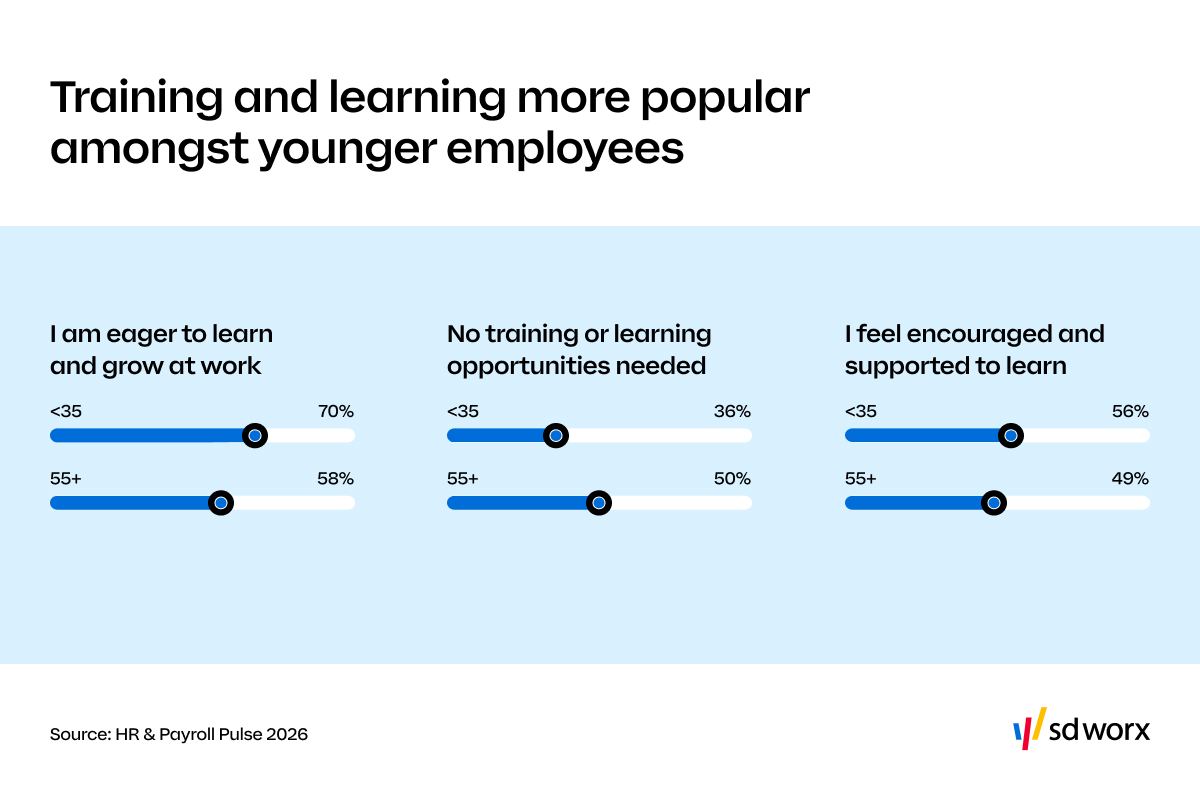
We also see this lower desire for change reflected in the need for training. About half of those aged 55 and older (50%) indicate that they have no desire for training, compared to just 36% of employees younger than 35. The latter look forward to further developing their skills (70%), compared to 58% of older employees. At the same time, the greater experience of older employees also seems to give them confidence in a rapidly changing job market.
Confidence in automatisation and skills
This higher level of engagement and self-confidence among older employees also translates into how they view their future, including the rise of AI. 61% of those aged 55 and older feel confident about their own jobs, even when automation changes their roles or tasks. Among employees under 35, that figure is 53%.
Notably, that confidence does not seem to stem from greater familiarity with AI. Only 20% of those aged 55 and older regularly use AI tools in their daily work, compared to 38% of employees under 35. Yet 74% of those aged 50 and older are convinced that their unique human skills cannot be replaced by AI, compared to 64% of younger employees.
Still, employers have their work cut out for them: only 17% of those aged 55 and older currently feel they receive sufficient support to prepare for an AI-driven future. Among employees under 35, that figure stands at 29%.

About SD Worx
SD Worx is the leading European HR, Pay and Time partner, helping organisations run the essential processes that employers and their people rely on every day, from paying employees correctly to managing time, data and compliance across the employee lifecycle.
As the backbone of work, SD Worx brings together technology, expertise and service delivery in one integrated solution. This allows organisations across Europe to manage HR, Pay and Time in a consistent and reliable way, supported by local knowledge in each market and a strong European presence. The solutions create room to grow and are designed to support day-to-day operations, giving organisations confidence.
SD Worx supports more than 100,000 organisations, pays over 6 million employees each month and achieved revenues of EUR 1.3 billion in 2025.
More information on www.sdworx.com / Follow us via LinkedIn.
Press contact