More than six in ten European employees see time recording as beneficial
Older employees are particularly positive about recording working hours
November 24, 2026
Employee monitoring is a regular part of the working day for many European employees. From digital time recording to monitoring work activities, 62% say their employer monitors their work or activity in some way, while 76% have their working hours recorded. Most do not necessarily see this as a form of control. In fact, 63% of European employees believe that recording working hours benefits both employers and employees. Older employees, in particular, recognise its added value. These are findings from the HR & Payroll Pulse, an international survey by European HR services provider SD Worx.
From Slovenia to Sweden: major differences in employee monitoring
How common monitoring is varies considerably across European countries. In Slovenia, eight in ten employees (80%) say their work or activity is monitored. Romania (75%), Finland (72%) and Croatia (72%) also have notably high figures. At the other end of the scale is Sweden, where fewer than half of employees (45%) say their work is monitored. The Netherlands (50%) and Belgium (52%) are also below the European average of 62%.
The way employees record their working hours varies too. On average, 57% of European employees record their own working time: 41% do so every day, while 16% do so occasionally or for specific projects. For 19%, working hours are monitored automatically using digital tools. A quarter (24%) of those surveyed do not have their working hours recorded.
Notably, 63% of all employees surveyed consider time recording beneficial for everyone involved. Among employees who actually record their hours, that figure rises to 67%. Even among those who do not, 53% still see the benefits.
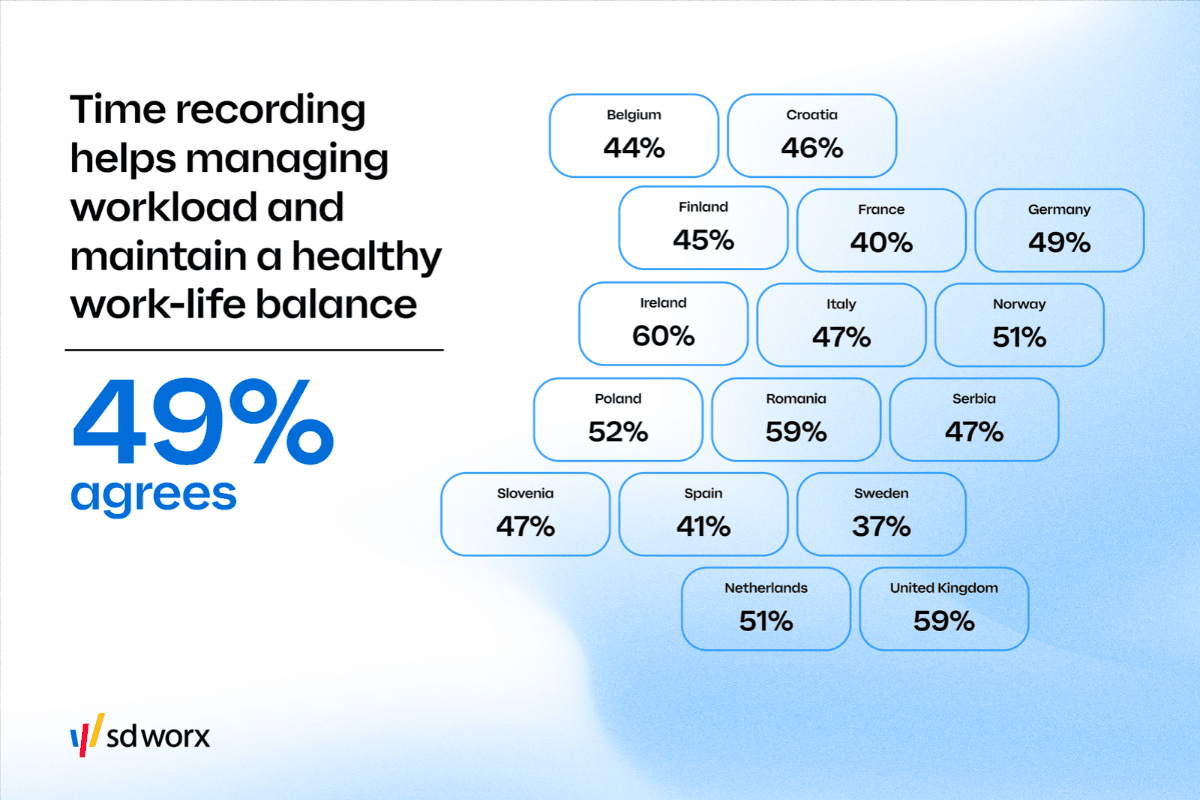
One such benefit is that time recording can help employees manage their workload more effectively. Almost half (49%) of European employees who record their working hours say it helps them keep their workload under control and maintain a healthy work-life balance. There are clear differences between countries here, too. In Ireland (60%), Romania (59%) and the United Kingdom (59%), a majority see this benefit. The figure is considerably lower in Sweden, at 37%. Spain (41%), France (40%) and Belgium (44%) are also below the European average.

Younger employees are monitored more often
Although employees generally recognise the benefits of time recording, how often they are monitored varies by age. The survey shows that younger employees are monitored more often. Among employees under 25, 75% say their work or activity is monitored in some way. This compares with 56% of those aged 50 to 64, while the figure falls to below half (49%) among employees aged 65 and over. Notably, older employees are monitored less often but are more likely to recognise the added value of time recording.
About SD Worx
SD Worx is the leading European HR, Pay and Time partner, helping organisations run the essential processes that employers and their people rely on every day, from paying employees correctly to managing time, data and compliance across the employee lifecycle.
As the backbone of work, SD Worx brings together technology, expertise and service delivery in one integrated solution. This allows organisations across Europe to manage HR, Pay and Time in a consistent and reliable way, supported by local knowledge in each market and a strong European presence. The solutions create room to grow and are designed to support day-to-day operations, giving organisations confidence.
SD Worx supports more than 100,000 organisations, pays over 6 million employees each month and achieved revenues of EUR 1.3 billion in 2025.
More information on www.sdworx.com / Follow us via LinkedIn.
Press contact