More than 4 in 10 European HR professionals are redesigning HR models to ensure optimal collaboration between AI and employees
June 2, 2026

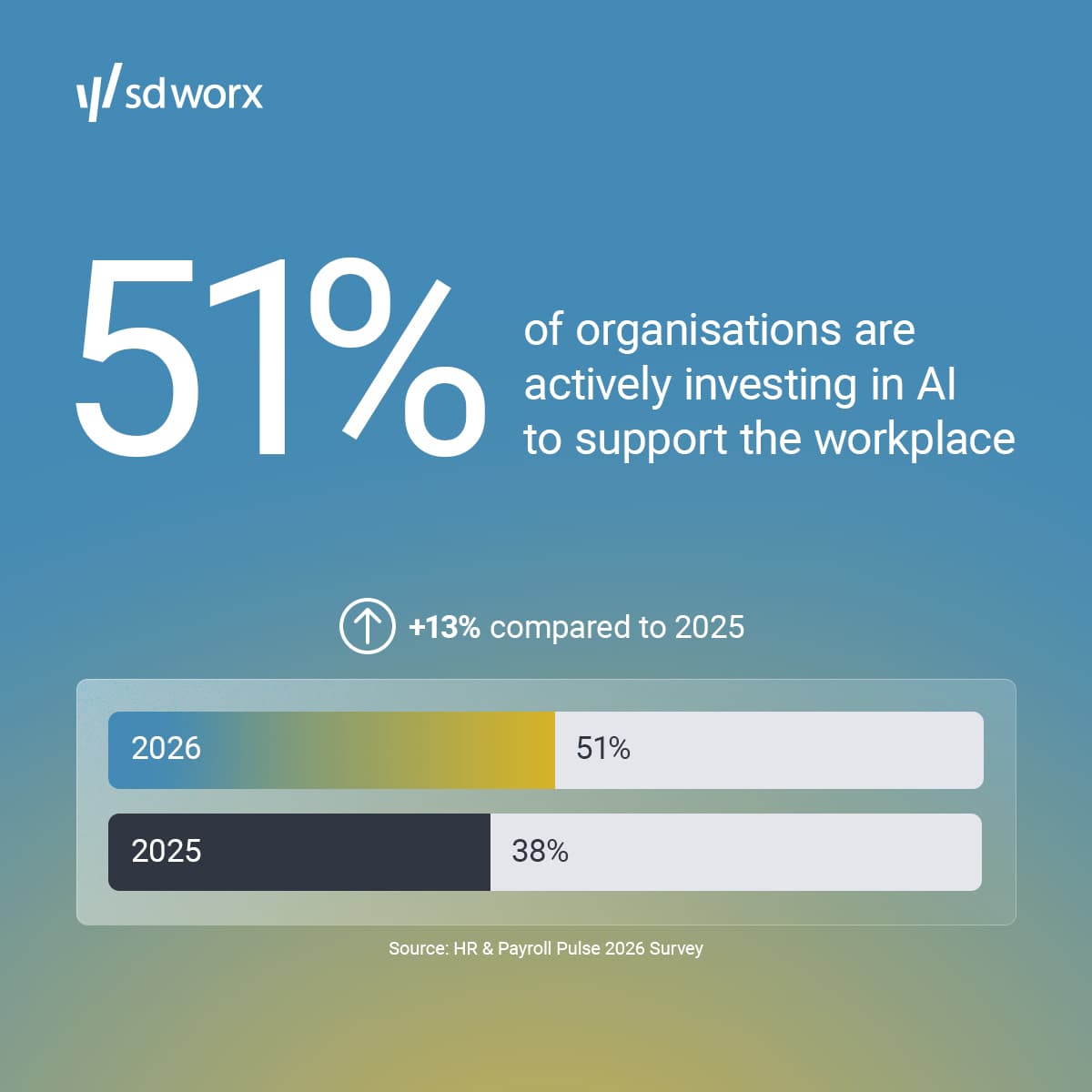
More than half (51%) of European HR professionals are investing in AI to support the workplace. That is a third more than the 38% recorded in 2025. Four in ten organisations are already seeing clear results from those investments today. Organisations that are less advanced mainly encounter work processes that are insufficiently aligned with AI (36%) and a lack of internal expertise (32%). At the same time, more than four in ten organisations (45%) are actively adapting their work processes for a workplace where humans and AI collaborate more closely. Just under half of employers (47%) have a policy for ethical and responsible AI use within HR. These findings come from the most recent HR & Payroll Pulse, a survey conducted by the leading European HR and payroll solutions provider SD Worx among 5,936 HR managers and 16,500 employees in sixteen European countries.More and more organisations are exploring the possibilities of artificial intelligence. For example, 54% of European HR professionals are currently actively investigating how AI can support the workplace, compared to 42% in 2025. More than half (51%) are also actively investing in AI, up from just 38% last year.
Medium-sized companies with 250 to 2,499 employees are particularly likely to invest in AI to support the workplace (57%). The figure stands at 51% for large enterprises and 45% for companies with fewer than 250 employees. Norway saw the sharpest increase in Europe, with 68% of employers investing in AI this year, compared to just 36% in 2025. Ireland (59%) and the United Kingdom (59%) are also strongly committed to investing in AI.
Preference for a combination of people and AI
Where do HR professionals see the greatest role for AI today? Employers primarily cite time tracking (31%), reporting and analytics (28%), and payroll management (27%) as priority HR areas for AI use and development. Staff planning and scheduling (27%) and training and development (25%) are also among the top AI priorities within HR.
Most employers do not yet see AI as fully replacing humans in HR. A combination of humans and AI is particularly preferred. For example, 33% believe that time tracking can be partially automated, as long as human oversight is maintained. For reporting and analytics, this figure is 38%, and for payroll management, 40%. Employers also ideally envision a collaboration between humans and AI in workforce planning and scheduling (39%) and training and development (41%). Employers still prefer to entrust more human-centric HR domains, such as employee well-being and mental health support, entirely to humans (51%).
More than a third prefer AI over hiring additional staff
AI is thus gradually shifting from the experimental phase to practical application in day-to-day HR operations. For example, 43% of organisations are adapting their HR operating models to enable better collaboration between people and AI. In addition, 45% are actively redesigning work processes and workflows to create a workplace centred on AI and automation. Four in ten employers are already seeing concrete results from such AI investments in HR.
This evolution is also having a clear impact on how organisations view work and their workforce. For instance, 45% of employers expect to operate with a smaller workforce in the coming years as a result of AI. Nearly half (47%) also indicate that AI is already reducing the need for certain roles or tasks. Norway stands out in this regard with 60%, followed by Ireland (57%) and Poland (54%). To boost productivity, more than a third of employers (37%) would also be more likely to deploy AI than to hire additional staff.
AI-maturity in Europe
However, a lack of internal skills and expertise continues to hold many organisations back: 32% say they lack the in-house knowledge needed to deploy AI effectively. More than four in ten employers (44%) are, however, investing in employee training to strengthen their AI skills. Finally, 30% of employers cite the lack of a clear AI strategy or business case as a key reason why AI projects are currently yielding few results.
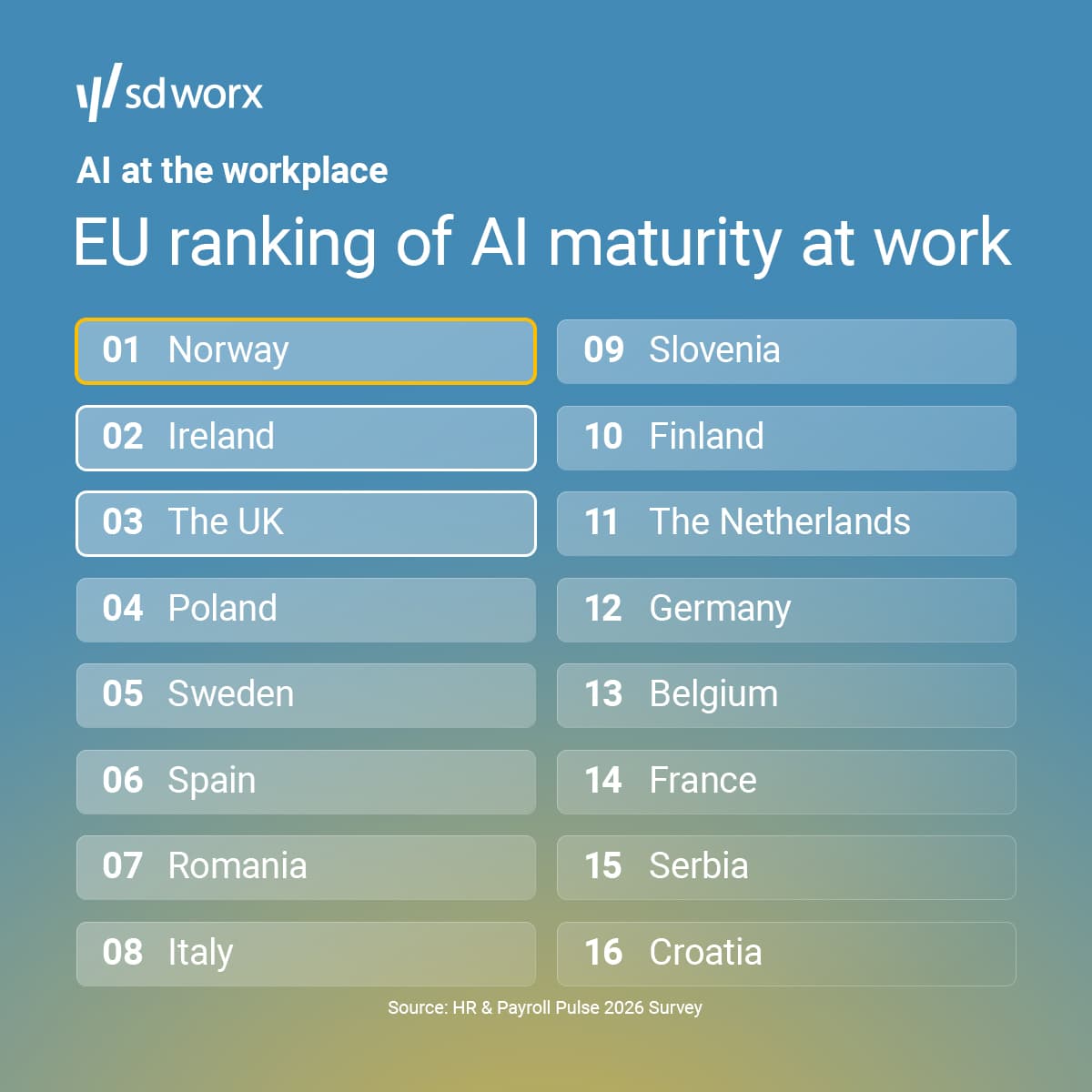
The speed at which organisations are adopting AI varies greatly from country to country. In terms of AI maturity, Norway currently leads the European list. Ireland and the United Kingdom round out the top three, while Poland and Sweden finish just off the podium in fourth and fifth place. Croatia and Serbia lag at the bottom of the ranking.
SD Worx assessed organisations’ AI maturity based on six areas. Among other things, it examined how organisations are exploring the potential of AI in the workplace, investing in AI solutions, upskilling and reskilling employees for an AI-driven future, and adapting workflows to AI and automation. It also examined how organisations are scaling AI solutions across different business units and to what extent they are already achieving concrete results with AI within HR. Based on this, Norway emerged as the winner.

Postponing AI Act deadline for high-risk AI?
As AI is being applied in more and more situations, Europe introduced the AI Act, a uniform legal framework with which all companies within Europe must comply. The law applies to all employers, came into effect on 2 February 2025 and is being phased in gradually.
Since 2 February 2025, companies must ensure that their workforce is sufficiently AI literate and identify the AI systems being used to avoid AI systems that violate European fundamental norms and values, for example because of a violation of fundamental rights. Since 2 August 2025, organisations that develop or deploy prohibited AI systems risk heavy fines.
The next deadline within the AI Act is 2 August 2026. As from then, organisations using high-risk AI will face stricter requirements around documentation, risk assessments, transparency, and governance. However, a request has been submitted to postpone the deadline for regulations on high-risk AI until 2 December 2027, although the proposal has not yet been formally approved. To be continued …
About the European survey HR and Payroll Pulse
SD Worx, the leading European provider of HR and payroll solution, supports both small and large organisations in addressing their HR and payroll challenges. To stay in touch with employers and employees, SD Worx regularly conducts in-depth surveys across Europe. The analysis of the most recent “HR & Payroll Pulse” survey offers organisations valuable insights to refine their HR and payroll strategies and make them future-proof.
The survey was conducted between January 27 and February 20, 2026, in 16 European countries (Belgium, Croatia, Finland, France, Germany, Ireland, Italy, Norway, Poland, Romania, Serbia, Slovenia, Spain, Sweden, the Netherlands and the United Kingdom) by the SD Worx Research Institute. A total of 5,936 HR decision-makers and 16,500 employees were surveyed. The results provide a representative picture of the labor market in each country.
About SD Worx
SD Worx is the leading European HR, Pay and Time partner, helping organisations run the essential processes that employers and their people rely on every day, from paying employees correctly to managing time, data and compliance across the employee lifecycle.
As the backbone of work, SD Worx brings together technology, expertise and service delivery in one integrated solution. This allows organisations across Europe to manage HR, Pay and Time in a consistent and reliable way, supported by local knowledge in each market and a strong European presence. The solutions create room to grow and are designed to support day-to-day operations, giving organisations confidence.
SD Worx supports more than 100,000 organisations, pays over 6 million employees each month and achieved revenues of EUR 1.3 billion in 2025.
More information on www.sdworx.com / Follow us via LinkedIn.
Press contact