Seven out of ten European AI users say they work more efficiently thanks to AI
July 16, 2026

AI is increasingly finding its way into the workplace. Three in ten (29%) European employees use AI at least once a week to support their work. A quarter of all employees surveyed are concerned that AI will render a large proportion of their tasks redundant. Understandably, these concerns are higher among employees who already use AI today (38%). As AI becomes more prevalent in the workplace, so too does the demand for transparency and responsible use. Almost two-thirds of employees (64%) believe that AI systems should make it clear how they arrive at solutions. This is becoming increasingly important, as from 2 August the AI Act will impose stricter requirements regarding transparency obligations. The figures come from a survey conducted by the European HR service provider SD Worx among 5,936 HR managers and 16,500 employees in sixteen European countries.
A third of European workers (32%) are using AI more and more frequently in their day-to-day tasks. Managers, in particular, are making greater use of the technology: 41% are using AI more and more frequently, compared with 26% of non-managers. Interest is also growing among workers who do not yet use AI: 8% expect to use the technology more frequently in their day-to-day tasks in the future.
52 % of AI users receive support from their employer
Those who are already using AI today are reaping the benefits: 68% say they work more efficiently thanks to the technology. Yet only just over half (52%) of AI users receive sufficient support from their employer to develop the skills needed to make the most of AI. AI therefore clearly offers potential, but adequate support remains essential to realising that potential. Furthermore, such support is also mandatory: under the AI Act, European employers have been required since 2 February 2025 to take measures to ensure that employees and other individuals who use or manage AI systems on their behalf possess sufficient AI literacy. Employees do not need to be AI experts, but anyone working with AI must be able to use the technology responsibly and recognise the risks.
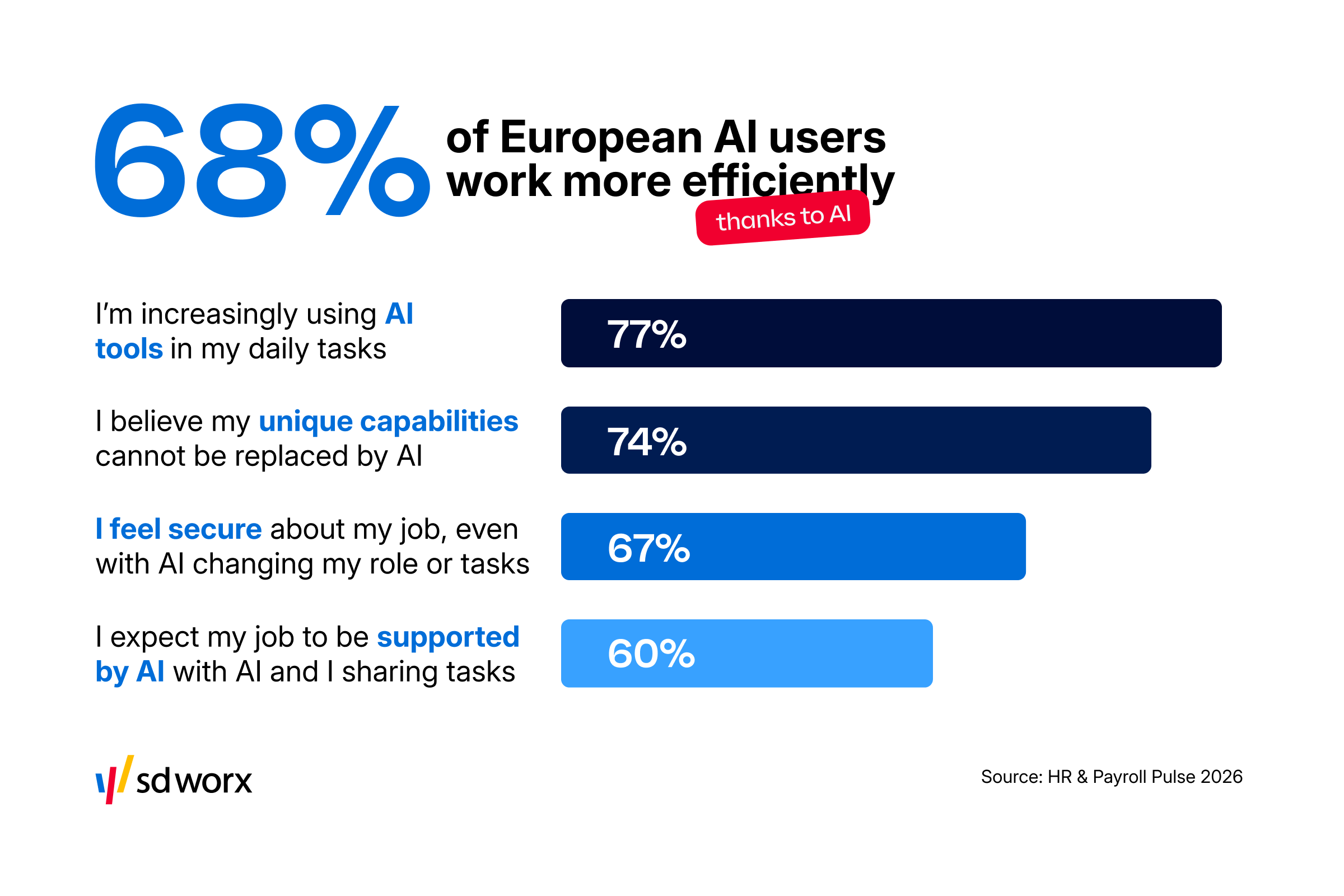
68% believe that AI cannot replace human qualities
Employees do, however, continue to believe in their own human capabilities: 68% believe that AI cannot replace their unique human qualities. Expectations vary regarding the ideal division of tasks between humans and AI. More than half of all employees surveyed (54%) expect to continue carrying out the majority of tasks themselves, with only limited support from AI. By contrast, nearly four in ten (39%) expect to share tasks with AI, with the technology playing a supporting role.
Employees who already use AI today clearly have different expectations to those who do not. For example, 72% of non-users expect to continue carrying out the majority of tasks themselves, compared with just 31% of AI users. AI users are more likely to view the future as a collaboration between humans and AI: six in ten employees expect to share tasks with AI, compared with 22% of non-users.
Just over half (52%) are confident that their organisation uses AI in an ethical and responsible manner. This is becoming increasingly important in light of the AI Act.
AI Act: Omnibus postpones key obligations for high-risk AI systems until 2027 and 2028
These findings come as employers prepare for the next phase of the EU AI Act. While key obligations for high-risk AI systems have been postponed to 2027 and 2028, transparency requirements will still apply from 2 August 2026. This means users must be able to recognise when they are interacting with AI, such as through a chatbot, while certain AI-generated outputs will also need to be clearly marked.
However, following the recent publication of the AI Omnibus which is expected to be published soon, relatively little remains of the originally planned ‘major wave’ on 2 August 2026. For the sake of completeness: a transitional arrangement is also provided for a limited technical aspect in this regard: providers of generative AI systems that generate synthetic audio, image, video or text content, and which were already on the market before 2 August 2026, will have until 2 December 2026 to comply with the obligation to mark that output in a machine-readable format.
About the international employee survey
SD Worx, the leading European provider of HR and payroll services, supports organisations of all sizes with their HR and payroll challenges. To keep its finger on the pulse of employers and employees, SD Worx regularly conducts in-depth surveys across Europe. The analysis of the most recent ‘HR & Payroll Pulse’ survey offers organisations valuable insights to refine their HR and payroll strategies and make them future-proof.
The survey was carried out between 27 January and 20 February 2026 in 16 European countries: Belgium, Germany, Finland, France, Ireland, Italy, Croatia, the Netherlands, Norway, Poland, Romania, Serbia, Slovenia, Spain, the United Kingdom and Sweden by the SD Worx Research Institute. A total of 5,936 HR decision-makers and 16,500 employees were surveyed. The results provide a representative picture of the labour market in each country.
About SD Worx
SD Worx is the leading European HR, Pay and Time partner, helping organisations run the essential processes that employers and their people rely on every day, from paying employees correctly to managing time, data and compliance across the employee lifecycle.
As the backbone of work, SD Worx brings together technology, expertise and service delivery in one integrated solution. This allows organisations across Europe to manage HR, Pay and Time in a consistent and reliable way, supported by local knowledge in each market and a strong European presence. The solutions create room to grow and are designed to support day-to-day operations, giving organisations confidence.
SD Worx supports more than 100,000 organisations, pays over 6 million employees each month and achieved revenues of EUR 1.3 billion in 2025.
More information on www.sdworx.com / Follow us via LinkedIn.
Press contact