1. Home>
  2. Resources>
  3. Payroll & Reward>
how an HR manager views pay transparency

How an HR Manager views EU pay transparency

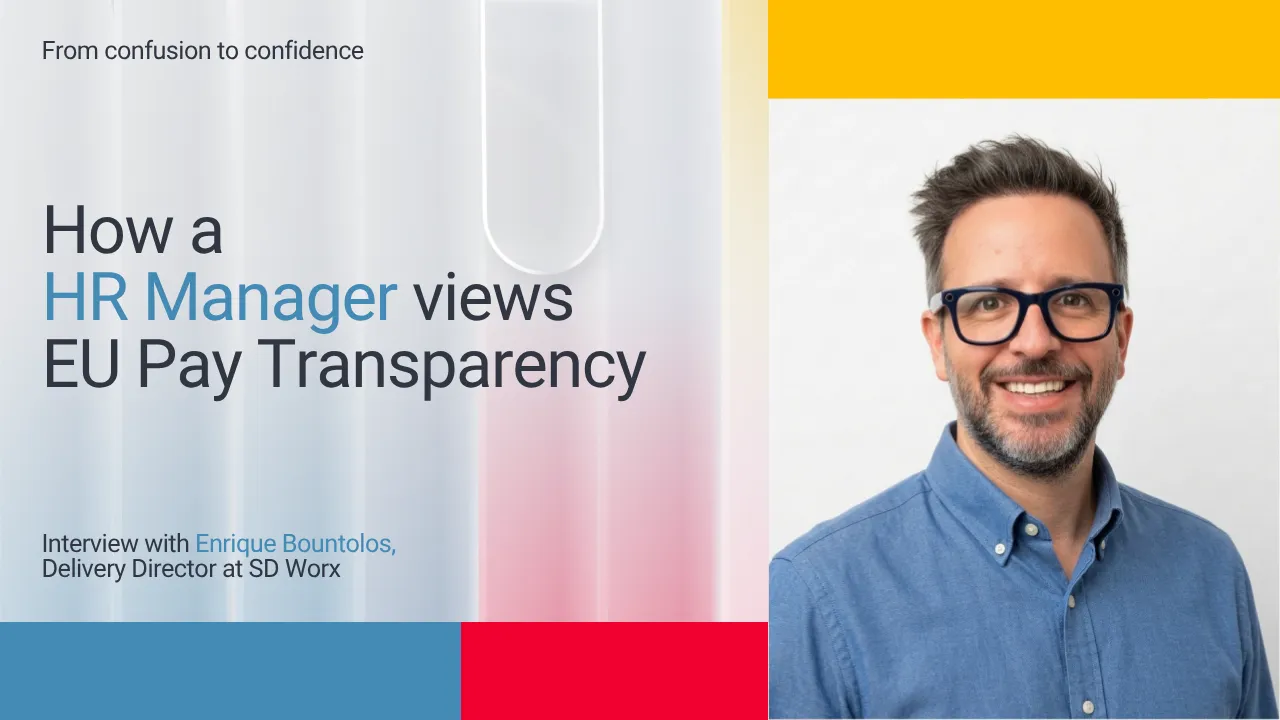
Interview with Enrique Bountolos, Delivery Director at SD Worx

The EU Pay Transparency Directive comes into effect in June 2026. It will introduce new rules on pay ranges, reporting, and information rights across Europe. To understand how these changes feel for colleagues in different roles and markets, we spoke with team members across SD Worx.  

In Spain, we sat down with Enrique Bountolos, SCP Country Delivery Director, to hear what pay transparency means in his daily work. 

    What pay transparency means in practice

    For Enrique, transparency begins with clarity. 

    “In practice it is to have a clear view about the salary or the threshold for each level. The company lets employees know the different thresholds, and each employee can check if they are well paid or not.” 

    He has been involved in setting up these processes: “In my previous role as a hub director for Spain, I was in contact with HR and partially responsible for pay transparency. I initiated this for Spain one year and a half ago.” 

    Enrique also believes knowing the structure matters more than knowing individual salaries. 

    “I don’t mind about my colleagues because you are the owner of your own salary. But it is good to know the ranges.” 

    He is clear about the limits: “It is not good to know where my colleagues are. It can generate bad responses or bad behaviours.” 

      How transparency works as a manager

      Enrique sees a direct responsibility to help his team access and understand pay information. 

      “I must let my team know that they have access to this information. They should feel accurate on their position and salary and use the tools we provide to check if they are well paid within the ranges.” 

      He feels confident explaining how pay is set: “We use the high‑level model. When an employee is hired, they know where they are, if they have a bonus or not. Every year we cascade the information about performance, bonus and how the year will be driven.” 

      He also trusts the information he receives: “My trust is high. Sometimes the gap happens when information is not cascaded in the right way. But personally, I have a high level of trust.” 

        How his team experiences transparency

        Enrique leads a small group of six people and has not faced any pay‑related disputes. 

        “I have not received any claim about payroll or how they are paid.” 

        Part of this comes from their own expertise: “They configure the Spanish payroll, so they know how it’s paid and they have the capacity to understand the details.” 

        On a personal level, he is comfortable raising questions. “I had my performance review last week. I have no problem being clear and transparent with my manager. I feel listened to and confident to ask.” 

          What concerns Enrique about transparency

          Enrique’s focus is accuracy: “The only thing that could worry me is that we are not paying correctly once we show the ranges. We need to be sure every employee is well paid.” 

          For him, transparency shifts the conversation towards development. 

          “The employee needs to check why they are in a range and what they need to do if they want to progress. It is more motivation and explanation.” 

            What information he finds useful

            Enrique feels well supported with the data available. 

            “In SuccessFactors we have our remuneration section. We can see monthly and annual salary and bonuses. I think we have access to all needed information.” 

            He believes that expectations should be discussed regularly: “Every six months at least. Twice a year is a good tempo.” 

            He also sees clear improvement from the people team. 

            “Since last year we have improved a lot. Cycles, dates and milestones are shared correctly.” 

              How he sees transparency evolving

              For Enrique, transparency and equity must evolve together and must be paired with career progression. 

              “Transparency is one thing. Equity between genders is also important. It’s also nothing if you do not have a clear career path. You need to know how you can evolve in a few years.” 

              He believes it builds trust from the outset “The biggest benefit is trust. If I look for a company, I will choose one that has a real implementation of pay transparency.”  

              Interested in learning more? Explore our pay transparency resources here.