1. Home>
  2. Resources>
  3. Payroll & Reward>
how a senior manager views pt graphic

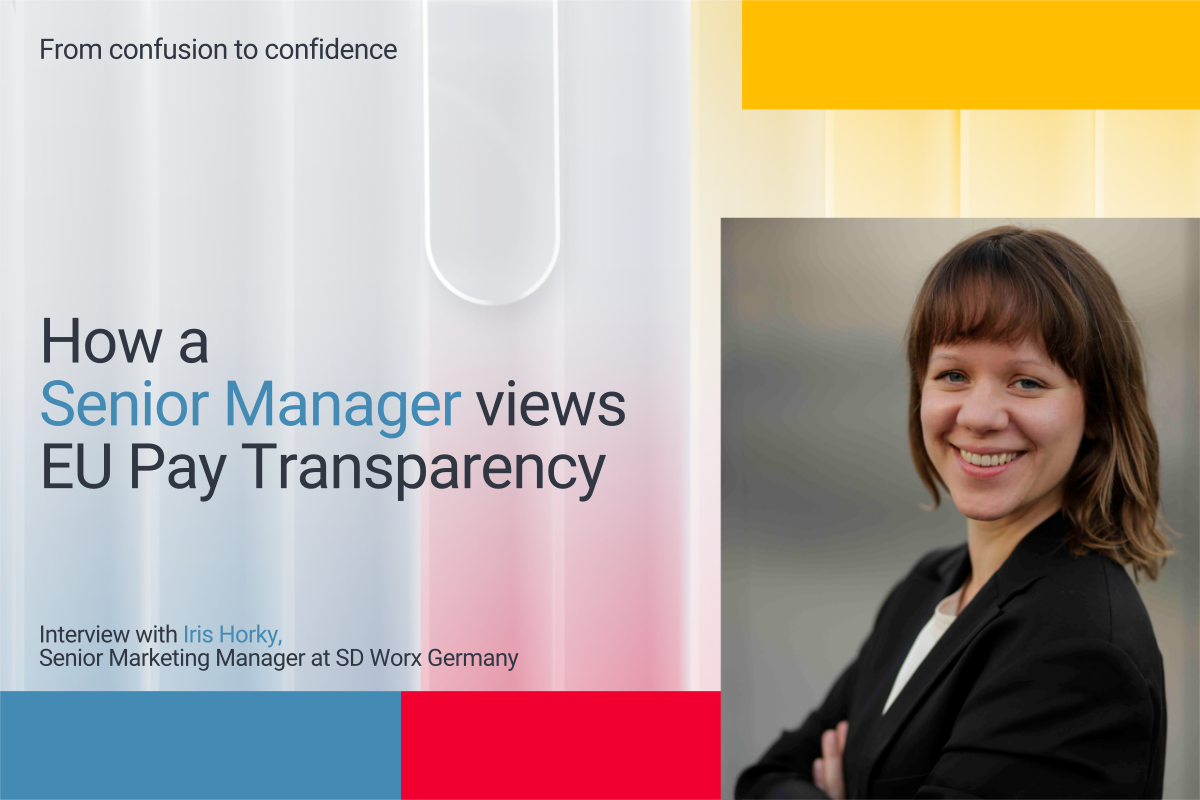
How a Senior Manager views EU pay transparency

Interview with Iris Horky, Senior Marketing Manager at SD Worx Germany

With the EU Pay Transparency Directive approaching, many employees across Europe are starting to think about how pay is set, communicated and structured.  

For some, these conversations are familiar. For others, the Directive opens a topic they have never fully considered before. To understand these different viewpoints, we spoke with colleagues across SD Worx.  

In Germany, we sat down with Iris Horky, who recently joined the marketing team, to hear how transparency looks from the perspective of a Senior Manager. 

    What pay transparency means to Iris

    For Iris, transparency begins with clarity around progression and the ranges behind each role. 

    “I hope it will mean that I know exactly where I am between the roles from junior level to professional level to a manager. At least an idea of a range and what I could expect.” 

    She sees pay bands as the most practical level of transparency: “Knowing a range of what is normal in a company is enough. Knowing the exact salaries of co‑workers would go too far.” 

    As someone who has worked across different sectors, she has often experienced inconsistent expectations when applying for roles. 

    “Companies always want you to say what you expect, and then I struggle so much putting down a number because it is so different from sector to sector. You don’t want to go too high or too low. A range gives a little bit more security.” 

      What information Iris finds useful

      Salary is only one part of a pay package, and Iris notes that benefits matter too, even if they vary by industry. 

      “It would be nice to know if there are some beneficial add‑ons. But I don’t think it needs to go too deep. Not everyone would be comfortable if everyone knew what they earn to the euro.” 

      She has not worked in environments with bonuses or variable pay but recognises that transparency there would also help people understand the full picture. 

        Trust and the role of HR

        When asked whether she trusts SD Worx to explain pay decisions, Iris reflects on past experiences where discussing pay was discouraged. 

         “In some companies it is written in the contract that you are not allowed to talk about your salary. If I have something like this written in my contract, I start thinking why. It feels dodgy.” 

        If she ever had doubts about fairness, she says knows where she would go: “I would talk to my manager first. I trust her. And then HR. But in the end, I still have to trust without seeing numbers, and that is a little bit difficult.” 

          How comfortable she feels discussing pay

          Iris is honest about her comfort level, saying: “Would I feel comfortable asking for a pay increase? No.” 

          “Where I come from, you are responsible for your wages yourself and you have to be very good at negotiating. If you negotiate badly at the start, bad luck.” 

          Despite this, she does not worry about transparency itself: “I wouldn’t mind if everyone knew what I earned, but I understand not everyone feels like that.” 

            What Iris expects from an employer

            Iris sees transparency as a sign of culture. 

            “I think it says a lot about the company and how it treats employees. Transparency reflects the culture here very well.” 

            When joining a new company, pay transparency plays a stronger role: “It’s important to know the wage ranges to feel confident giving an expected number. It makes things easier.” 

              What the ideal system looks like

              For Iris, the ideal approach is simple. “Not everyone would be comfortable with all details. But some wage ranges, the so‑called high stacks, would be amazing and enough.” 

              Talking about pay also makes her feel recognised: “It makes me feel seen as an employee. That is great.” 

              Interested in learning more? Explore our pay transparency resources here