1. Home>
  2. Resources>
  3. Payroll & Reward>
How a managing director views pt

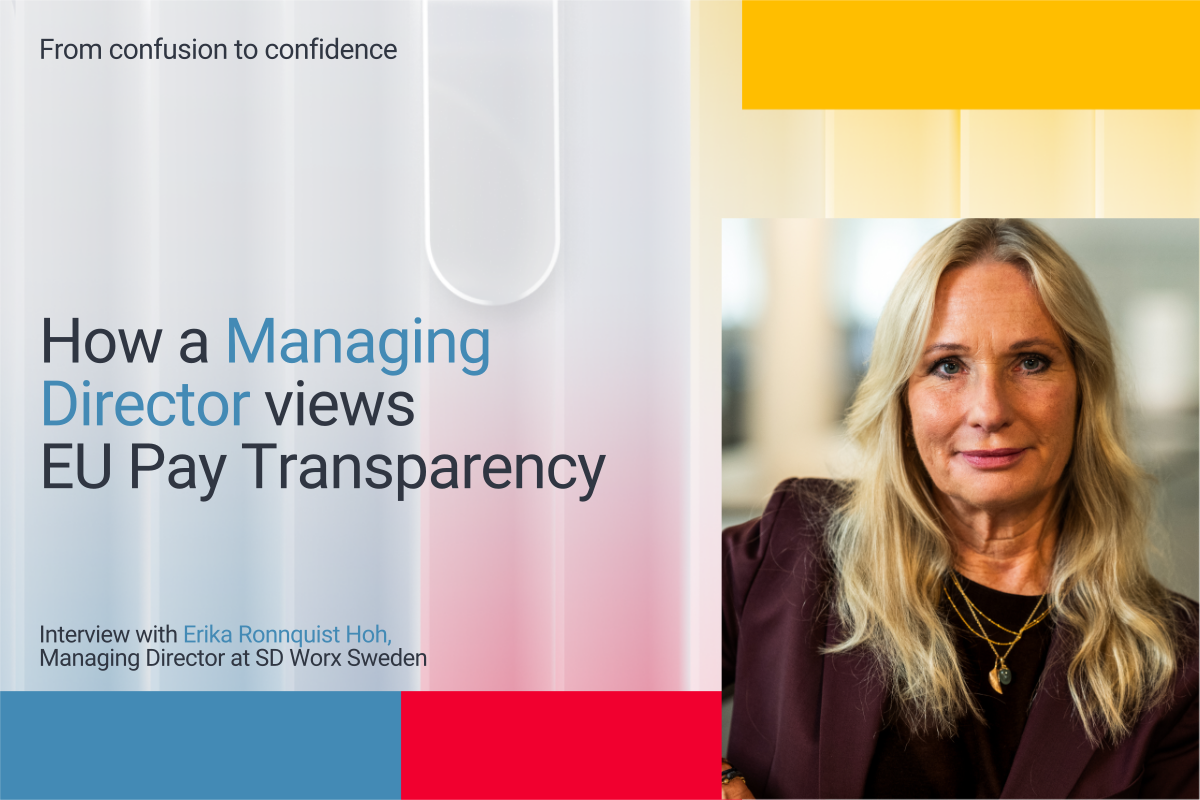
How a Managing Director views EU pay transparency

Interview with Erika Ronnquist Hoh, Managing Director at SD Worx Sweden

The EU Pay Transparency Directive will begin reshaping how organisations report and explain pay decisions across Europe.  

With new rules on pay structures, fairness, and reporting cycles, many countries will adapt their processes in the coming years. In Sweden, some of this work is already part of established practice.

To understand what these changes mean in real workplaces, we spoke with colleagues across SD Worx.  

In Sweden, we sat down with Erika Rönnquist Hoh to hear how transparency fits into culture, legislation and daily working life. 

    What pay transparency means in practice

    For Erika, pay transparency needs to have a systemic approach. 

    “In practice, it means to have a systematic work on pay at a specific interval. It could be annually. In Sweden, it depends on the size of the company.” 

    She emphasises that the goal is equality across multiple dimensions. 
    “It means to ensure we are not doing any discrimination in terms of gender, sexual orientation, religion or other minority ethnicities.” 

    Sweden already has longstanding expectations around this work: “With an annual interval, you need to do a systematic mapping of all salaries in the company. That is already law.” 

    The openness around pay in Sweden often surprises colleagues in other countries. 

    “You can look everybody up. Newspapers are also very willing to expose people’s salaries. That is one aspect. But that does not replace the systematic work that employers must do.” 

      How Sweden’s culture shapes the transition

      Erika believes Swedish companies may find the shift easier than some. 

      “Most companies already have processes that form a foundation. It might be more easy to go with the pay transparency direction since the processes are already in place.” 

      The national role is also clear: “This will be handled by the Equality Ombudsman, which is a government agency. They ensure salary and payroll is equal in all companies in Sweden.” 

        Where Erika sees opportunities

        Erika sees pay transparency as part of the broader work SD Worx does: “We can enable and support society with tools that facilitate this for everyone. SD Worx Payroll and SD Worx HR will be important solutions.” 

        Internally, she expects a clear, structured approach. 

        “We will do this as a very thorough project. We use our own payroll system, and we will have an automatized integration to the Equality Ombudsman.” 

        She also sees this becoming a clear offer to customers: “We will be able to perform the actual data transmission in a structured way. It is important that we package this as a solution for the market.” 

          How Erika views fairness and pay discussions

          Payroll is a topic that matters everywhere. 

          “Everybody wants to have fair pay. We want to be paid according to what we perform and the responsibilities we have.” 

          In Sweden, openness does not always mean free discussion: “Even if everything is open and transparent, it is not very common that you ask your pal what the salary level is.” 

          “People compare a lot in Sweden. But because the norm setting is quite equal, most often you will see it is similar.” 

          Concerns rarely centre on fairness between colleagues: “Fairness is not a very strong topic for us. More often it is the level itself and the sense that one’s responsibilities deserve a higher salary.” 

          She also explains that conversations also vary by position, saying: “The higher the salaries and the positions in the company, the less people tend to speak about their salaries. On the floor, people speak more openly.” 

            Looking ahead

            For Erika, the Directive aligns with the direction Sweden is already moving. 

            “It is important that we do this according to compliance and legal regulations, and that we also take the opportunity to package it for customers.” 

            Her reflections highlight the differences between countries but also the shared goal of creating workplaces where pay is transparent, fair and grounded in clear processes. 

            Interested in learning more? Explore our pay transparency resources here